

The Black Fire Ant
The Black Fire Ant (Solenopsis richteri) is the lesser-known cousin of the more notorious Red Imported Fire Ant. It was introduced to the United States around 1918, decades before its red counterpart, through the port of Mobile, Alabama. Despite that head start, it never spread widely. Today its established range is concentrated in a small region of northern Mississippi and Alabama, and it’s rare to find in coastal southeastern North Carolina.
This page exists as an identification resource. If you’re trying to determine which fire ant species you have, this information will help you rule the Black out. In coastal NC, the answer is almost always Red Imported Fire Ants.
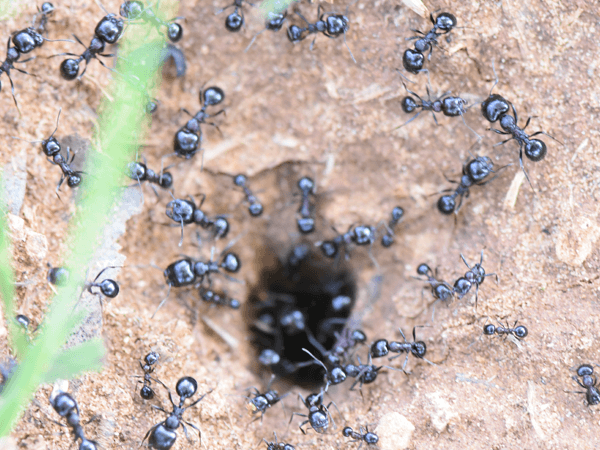
Quick Identification
- Size: 1/16 to 1/4 inch (workers vary in size within the same colony)
- Color: Uniformly dark brown to black throughout the body
- Distinguishing features: Two-node petiole (waist), 10-segmented antennae with a two-segment club, painful sting on contact
- Mounds: Dome-shaped loose soil, similar in appearance to Red Imported mounds
Range in the United States
Black Fire Ants occupy a relatively small geographic footprint:
- Established range: Northern Mississippi, northern Alabama, parts of Tennessee
- Where they're rare: Most of the Southeast, including all of coastal North Carolina
- Why their range is limited: They were displaced by the more aggressive Red Imported Fire Ant, which spread faster and outcompeted them
How to Tell Black from Red Imported
The two species look similar at a glance, behave identically, and sting just as painfully.
The reliable identifier is color:
| Feature | Red Imported | Black | Hybrid |
|---|---|---|---|
| Color | Reddish-brown head/thorax, darker abdomen | Uniformly dark brown to black | Intermediate, variable |
| Range in coastal NC | Dominant species | Extremely rare | Extremely rare |
| Mound appearance | Dome-shaped, loose soil | Same dome shape | Same dome shape |
| Sting | Severe, painful | Severe, painful (identical) | Severe, painful (identical) |
| Treatment approach | Bait + direct mound treatment | Same as RIFA | Same as RIFA |
If you’re in coastal NC and have fire ants, the simplest explanation is correct: they are Red Imported.
Visit the Red Imported Fire Ant page for full identification details, sting information, and treatment specifics.

Why They Matter (When You Find Them)
- Aggressive, painful stings when their mounds are disturbed
- Same venom (solenopsin) producing the same burning sensation and pustules
- Same allergic reaction risk in sensitive individuals
- Same equipment damage potential in AC units and electrical boxes
How Healthy Home Handles Fire Ant Treatment
- Broadcast bait across the yard so workers carry it back to the queen
- Direct mound treatment for active visible mounds
- Quarterly maintenance to prevent new colonies from neighboring properties
Healthy Home’s protection plans cover all fire ant species under one service.
Covered Under:
- Home + Yard Protection ($935/year)
- Home + Mosquito Protection ($1,250/year)
- Ultimate Protection Plan ($1,545/year)
- Essential Home Protection (does not include yard treatment)
Frequently Asked Questions
Almost never. They are concentrated in a small region of northern Mississippi and Alabama. Coastal NC is well outside their established range.
Black Imported are uniformly dark brown to black throughout. Red Imported have a reddish-brown head and thorax with a darker abdomen. Sting and behavior are otherwise identical.