

Crazy Ants in Coastal Southeastern North Carolina
Crazy ants get their name from their erratic, unpredictable movement. Unlike most ant species that travel in orderly trails, crazy ants run in zigzag patterns at high speed, often appearing scattered and disorganized. They’re a relatively new invasive species in coastal NC and have become increasingly common in recent years.

How to Identify Crazy Ants
- Size: 1/8 inch (small)
- Color: Reddish-brown to dark brown
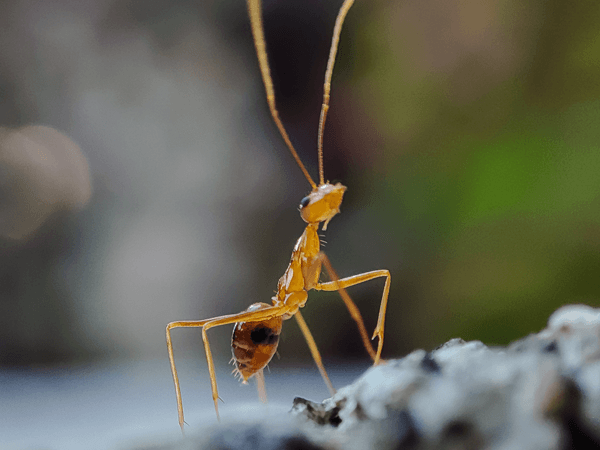
- Shape: Single-segmented waist, long legs and antennae
- Antennae: Very long, much longer than the body
- Behavior: Erratic, fast, zigzag movement (the most distinctive feature)
- Trial behavior: Less organized than most ant species, often scattered
The long antennae and erratic movement together are reliable identifiers.
Where Crazy Ants Nest
Crazy ants are opportunistic nesters and will set up in unusual locations:
- Inside electrical equipment (AC units, electronics, alarm systems)
- Under stones, logs, and mulch
- In wall voids and ceiling voids
- Inside potted plants
- In any small protected space, including unusual ones like the inside of garden hoses
This nesting flexibility makes them particularly difficult to control with single-treatment approaches.
How to Tell Black from Red Imported
The two species look similar at a glance, behave identically, and sting just as painfully.
The reliable identifier is color:
| Feature | Red Imported | Black | Hybrid |
|---|---|---|---|
| Color | Reddish-brown head/thorax, darker abdomen | Uniformly dark brown to black | Intermediate, variable |
| Range in coastal NC | Dominant species | Extremely rare | Extremely rare |
| Mound appearance | Dome-shaped, loose soil | Same dome shape | Same dome shape |
| Sting | Severe, painful | Severe, painful (identical) | Severe, painful (identical) |
| Treatment approach | Bait + direct mound treatment | Same as RIFA | Same as RIFA |
If you’re in coastal NC and have fire ants, the simplest explanation is correct: they are Red Imported.
Visit the Red Imported Fire Ant page for full identification details, sting information, and treatment specifics.
The Electronics Problem
Crazy ants are strongly attracted to electrical fields. They commonly nest inside:
- Air conditioning condenser units
- Computer cases and electronics
- Alarm system control panels
- Light fixtures and outlets
- Pool equipment and irrigation control boxes
In some cases, infestations have shorted out equipment by interfering with electrical components. This is similar to the problem fire ants cause with electrical equipment.
How Healthy Home Treats Crazy Ants
Crazy ants are covered under all four annual protection plans. Treatment requires:
- Thorough inspection to identify nesting sites (which can be unusual)
- Bait formulations that crazy ants will accept (some baits don't work well on this species)
- Treatment of electrical equipment harborage areas
- Quarterly follow-up due to crazy ants' rapid population growth
Healthy Home’s protection plans cover all fire ant species under one service.
Covered Under:
- Home + Yard Protection ($935/year)
- Home + Mosquito Protection ($1,250/year)
- Ultimate Protection Plan ($1,545/year)
- Essential Home Protection (does not include yard treatment)
Frequently Asked Questions
Crazy ants are named for their erratic, unpredictable movement. Unlike most ants that travel in organized trails, crazy ants run in random zigzag patterns, often at high speed. This behavior is one of the easiest ways to identify them.
Yes. Crazy ants are known for nesting in electrical equipment and can cause shorts and damage to AC units, alarm systems, computers, and other electronics. They’re attracted to the warmth and the electrical fields these devices produce.
No. The crazy ant found across most of coastal North Carolina is Paratrechina longicornis, sometimes called the longhorned crazy ant. Tawny crazy ants (Nylanderia fulva) are a related but distinct species that has caused problems further south in the U.S. Treatment approaches are similar for both species.