

Jumping Spiders in Coastal Southeastern North Carolina
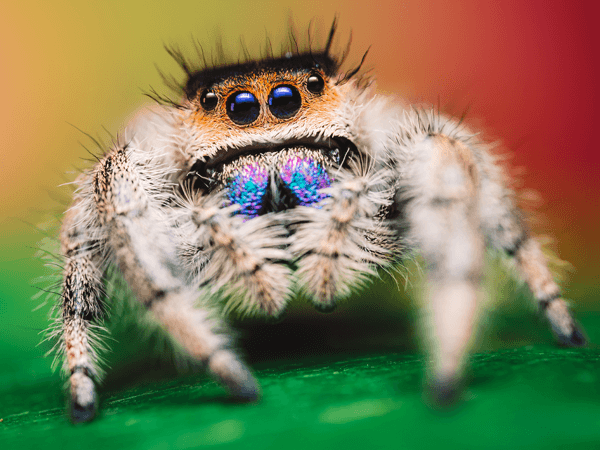
Jumping spiders are the small, alert spiders you’ll see hopping along windowsills, walls, and fence rails. They have unusually large, forward-facing eyes that give them a face-like appearance, and they’re widely considered the most charismatic spiders in our region. If you’ve ever had a spider seem to make eye contact with you and tilt its body to follow your hand, that was almost certainly a jumping spider.
They’re completely harmless to people and pets. Many people who are otherwise terrified of spiders find themselves charmed by jumping spiders. They’re the spider equivalent of a small, curious bird.
Quick Identification
- Size: Body 1/8 to 3/4 inch depending on species (most are very small)
- Color: Varies widely: black with white stripes (zebra jumper), iridescent colors, brown and tan, or boldly patterned
- Distinguishing features: Two very large forward-facing eyes (the largest of any spider); compact body; short, stocky legs; jerky, hopping movement
- Behavior: Doesn't build webs to catch prey; hunts by stalking and pouncing; uses silk only as a safety dragline
Common Jumping Spider Species in Coastal NC
Bold Jumper (Phidippus audax)
Black with iridescent green or blue chelicerae (mouthparts) and three white spots on the abdomen. About 1/2-inch body length. The most common large jumping spider in coastal NC.
Zebra Jumper (Salticus scenicus)
Black with white stripes across the abdomen and cephalothorax. Small (about 1/4 inch). Common on sunny windowsills and outdoor walls.
Tan Jumper (Platycryptus undatus)
Mottled gray-brown body that blends with bark. About 3/8 inches. Common on tree trunks and outdoor walls.
Why Their Vision Is So Good
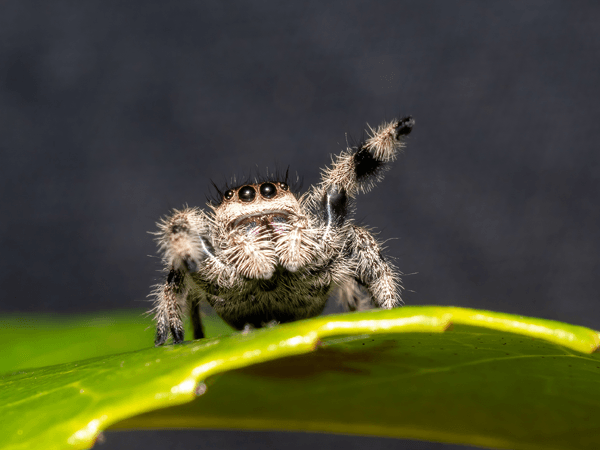
Jumping spiders have eight eyes in total, but the two large central eyes are the most striking feature. Those big eyes:
- Provide sharp, focused vision (far better than most spiders)
- Can detect colors and patterns
- Track moving objects accurately, including human faces
- Allow the spider to plan jumps with surprising precision
This is why jumping spiders seem to ‘watch you.’ They do see you, and they’re processing the information well enough to decide whether you’re a threat, prey, or just interesting.
Where You Find Them in Coastal NC
- Sunny windows and windowsills (especially indoors)
- Outdoor walls, especially light-colored siding in the sun
- Fence posts, deck railings, and porch furniture
- Tree trunks and shrubs
- Gardens and flower beds
- Around outdoor lights at night (hunting drawn-in insects)
Why They Matter (Mostly as Helpers)
- Indoor pest control: Jumping spiders eat small flies, mosquitoes, ants, and other indoor pests
- No webs: Unlike cobweb spiders, jumping spiders don't leave webs to clean up
- Don't establish populations: Indoor jumping spiders are usually single individuals; you won't get an infestation
- Harmless: They flee from threats, and their venom doesn't affect humans even if a bite occurs
- Visual nuisance: Some people are uncomfortable with spiders regardless of how harmless they are; that's the main reason for any treatment
How Healthy Home Approaches Jumping Spiders
Healthy Home generally doesn’t target jumping spiders specifically. Quarterly perimeter treatment reduces overall spider activity around the home, but we don’t recommend removing harmless beneficial species, such as jumping spiders. They’re net-positive in any home environment.
If a homeowner is uncomfortable with all spiders regardless of species, our standard service treats the foundation, eaves, and entry points where any spider would enter. Jumping spider populations decline naturally when prey populations are controlled.
Handling a Jumping Spider Indoors
If you find one and want to put it outside (versus letting it stay):
- Best method: gently coax it into a cup using a piece of paper
- Release in a garden bed, under a porch, or against a tree trunk
- Don't try to pick them up bare-handed; they may jump unpredictably (still won't bite, but they might startle you)
- They're more likely to survive relocation than other spider species because they're so adaptable
Covered Under:
- Home + Yard Protection ($935/year)
- Home + Mosquito Protection ($1,250/year)
- Ultimate Protection Plan ($1,545/year)
- Essential Home Protection (does not include yard treatment)
Frequently Asked Questions
No. Jumping spiders are harmless to people and pets. They’re reluctant to bite even when handled, and their venom is harmless to humans. They’re widely considered one of the most charismatic spider groups.
Because it actually is. Jumping spiders have the best vision of any spider group and can clearly see human faces and movement. The two large front-facing eyes track movement, which is why they often turn to watch you. They’re also intelligent for spiders and exhibit curiosity-like behavior.
Most homeowners (us included) leave them alone or relocate them outdoors. They’re beneficial because they hunt other insects, and they don’t establish indoor populations or build messy webs. A single jumping spider on a windowsill is a positive presence.
Sunny windowsills are jumping spider hunting territory. The warm surface and abundant insects attracted to windows make windowsills prime real estate. They’re using your window like a hunting perch.
Many jumping spiders can leap 20 to 30 times their own body length, which means a 1/2 inch spider can clear a foot or more in a single jump. They also use a silk safety line so they can climb back up if they miss.