

Paper Wasps
Paper wasps are the most common stinging insect found around coastal NC homes. Their umbrella-shaped nests appear under eaves, on porch ceilings, beneath grill lids, and tucked into outdoor light fixtures starting in spring. A small nest is easy to miss until someone walks under it.
Paper wasps are not as aggressive as yellow jackets, but they will sting hard to defend a nest, and the nest is usually closer to a door, window, or patio than you’d want.
How to Identify a Paper Wasp
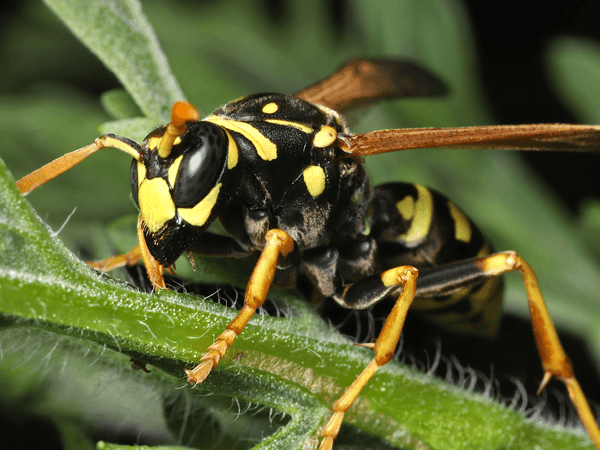
- Size: About ¾ to 1 inch long. Slimmer than a bumble bee, longer legged than a yellow jacket.
- Body: long, narrow waist between thorax and abdomen, the classic "wasp waist."
- Color: Most local species are reddish-brown with yellow markings. Some are darker brown to nearly black.
- Legs: long legs dangle visibly in flight, a key identifier from a distance.
- Flight: Slow, deliberate, often hovering near eaves and overhangs.
Identifying the Nest
The nest is usually easier to identify than the wasp itself:
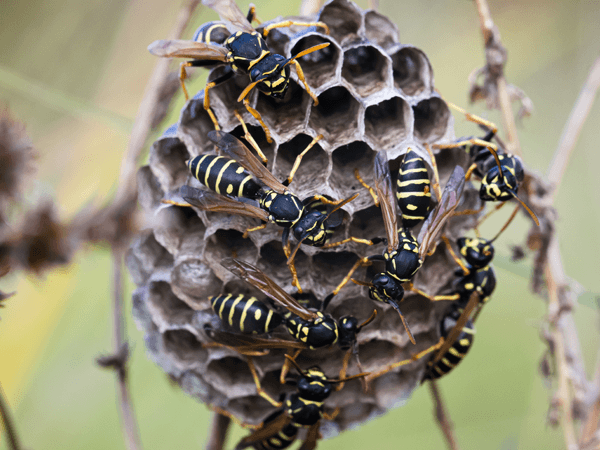
- Umbrella-shaped, attached to a flat surface by a single thin stalk
- Open hexagonal paper cells visible from below (no outer envelope covering them)
- Gray to tan color, made from chewed wood fiber
- Typical size: golf ball to softball, with 20 to 200 cells
- Usually attached under eaves, porch ceilings, deck railings, mailbox flags, or inside grills and outdoor furniture
Signs of a Paper Wasp Problem
- Slow-flying wasps with dangling legs returning repeatedly to one spot under an eave
- A small umbrella nest visible under the roof line, porch ceiling, or shutter
- Increased wasp activity around an outdoor light, especially at dusk
- Wasps emerging when a grill, shed, or mailbox is opened
- Wood-pulp-style scratching sounds from inside a hollow porch column or eave
Are Paper Wasps Dangerous?
Paper wasps are moderately defensive. Away from the nest, they’re focused on hunting caterpillars and gathering nectar, and they ignore people almost entirely. Within about 10 feet of the nest, that changes. Vibration, shadow, or fast movement can trigger an immediate attack.
Each wasp can sting repeatedly. Stings are painful and produce localized swelling for 24 to 48 hours. For anyone with a wasp venom allergy, a single sting can be a medical emergency.
Risk Factors Around the Home
- Nest above a frequently used door, where most stings happen during routine entry and exit
- Nest inside a grill or outdoor light, opens the grill or flips the switch, and discovers it the hard way
- Nest near a child's swing set or play area
- Power washing or painting season, when vibration sets off the colony
Treatment & Removal
Paper wasp nests should be treated professionally whenever they’re located near regular foot traffic. DIY sprays often kill only the wasps on the nest at the moment, leaving foragers to return, and an angry, partially treated colony is more dangerous than the original one.
Step 1: Inspection
A technician identifies every active nest on the property. Paper wasps often build multiple satellite nests, and finding all of them in one visit is key to preventing repeat stings.
Step 2: Direct Nest Treatment
Active nests are treated with a fast-knockdown product applied directly to the entry point, usually at dusk or dawn when all the wasps are on the nest. The nest is then physically removed, and the attachment point is treated to prevent rebuilding.
Step 3: Perimeter Treatment
A residual product is applied to typical nest locations (eaves, soffits, porch ceilings, deck rails) to deter new queens from establishing nests over the rest of the season.
New paper wasp queens start scouting for nest sites in early spring. Spring perimeter treatment is the single most effective way to prevent summer nests.
Preventing Paper Wasps
- In early spring, knock down any tiny starter nests (one or two cells with a single queen) before the colony grows
- Seal openings into hollow columns, hollow shutters, and unused light fixtures
- Inspect grills, sheds, and rarely used outdoor furniture before each use
- Keep eaves and soffits in good repair; peeling paint and rough wood are preferred nesting surfaces
- Hang a decoy wasp nest under the porch eave; paper wasps are territorial and avoid established colonies
Never knock down an active nest with a broom or hose. Both methods scatter the colony without killing it, leading to multiple stings.
Frequently Asked Questions
No. Paper wasps build open umbrella nests under eaves. Yellow jackets build enclosed nests, usually in the ground or in wall voids. Yellow jackets are also more aggressive, especially in late summer.
Possible, but risky. Store-bought sprays require you to stand within range of the colony. If the spray misses the queen or if any foragers are off the nest, the survivors return and rebuild. Multiple stings during a DIY attempt are common.
Yes. The attachment point retains pheromones that signal a safe nesting site to next year’s queens. Treating the attachment point after removal is what prevents the rebuild.
In coastal NC, paper wasps are active from late March through October, with the largest colonies and most defensive behavior in July and August.
After dark or just before dawn, when all the wasps are on the nest and movement is slow. That said, professional treatment is much safer than attempting it yourself, even at night.
Plan Coverage
Paper wasp inspection, treatment, and prevention are included on Home + Yard, Home + Mosquito, and Ultimate Protection Plans. Quarterly visits include perimeter treatment of eaves and soffits during nesting season.