


Carpenter Bees Wilmington NC: Signs, Damage & Control
If you have noticed large, black bees hovering around your deck, porch, or eaves, you may be dealing with carpenter bees. Carpenter bees in Wilmington, NC are one of the most commonly misunderstood pests homeowners encounter in the spring. They look intimidating, but they are not aggressive. The real danger is not the sting. It is the damage they do to your home.
In this post, we will cover how to identify carpenter bees, what kind of damage they cause, why Wilmington homeowners need to take them seriously, and what you can do to protect your property before the problem gets out of hand.
What Are Carpenter Bees? 
Carpenter bees are large, solitary bees that bore holes into wood to build their nests. Unlike honeybees or bumblebees, they do not live in colonies or build hives. Each female carpenter bee works alone, drilling her own tunnel to lay eggs and raise her young.
At first glance, carpenter bees look almost identical to bumblebees. Both are large and black and yellow. However, there is one easy way to tell them apart. Bumblebees have fuzzy, yellow-covered abdomens. Carpenter bees have shiny, smooth black abdomens. If you see a large bee with a glossy black backside hovering near your wooden structures, you are almost certainly looking at a carpenter bee.
The males are the ones you will notice most. They hover aggressively near nesting areas and dive-bomb anyone who gets close. However, male carpenter bees do not have stingers. They are all bluster and no bite. The females can sting, but they rarely do unless directly handled.
Why Carpenter Bees Are a Problem in Wilmington, NC
Wilmington’s warm, humid climate makes it ideal for carpenter bees. They are most active from early spring through summer, which lines up almost perfectly with the time of year when most homeowners are spending time on their decks and porches. That overlap is frustrating, but the bigger concern is what those bees are doing to your wood.
The Damage Is More Serious Than It Looks
Carpenter bees drill nearly perfectly round entry holes, roughly half an inch in diameter, into unfinished or weathered wood. From the outside, a single hole does not look like much. But inside the wood, the female bees excavate tunnels that run six to ten inches parallel to the wood grain. Over time, these galleries weaken the structural integrity of beams, railings, decks, fascia boards, and siding.
Here is where the damage compounds: carpenter bees return to the same nesting sites year after year. Each new generation expands the existing tunnels. What starts as one small hole can become a network of interconnected galleries that causes serious structural damage over several seasons.
Furthermore, carpenter bees attract a secondary problem — woodpeckers. Woodpeckers can hear the larvae moving inside the wood. They tear into the surface to reach them, causing additional damage that is far more visible and costly to repair than the original bee holes. This combination of bee damage and woodpecker damage is one of the more expensive home repair scenarios Wilmington homeowners face.
How to Tell If You Have Carpenter Bees
Not sure if what you are seeing is actually a carpenter bee infestation? Here are the most common signs to look for.
Round Entry Holes in Wood 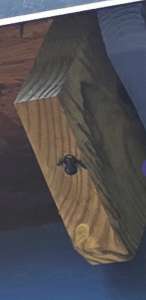


The clearest sign of carpenter bees is a round, smooth hole about the size of a dime in an unpainted or weathered wooden surface. Check the underside of deck railings, porch beams, fascia boards, window trim, and wood siding. The holes will almost always be drilled on the underside or end grain of the wood, where rain is less likely to enter.
Yellow Sawdust Below the Entry Point
When a carpenter bee bores into wood, she creates a fine yellow sawdust called frass. If you notice a small pile of sawdust-like debris beneath a hole in your wood, that is a strong indicator that a carpenter bee has been at work recently.
Hovering Bees Near Eaves and Structural Wood
Male carpenter bees are highly territorial. If you see one or more large bees hovering persistently near the same spot on your home — especially near eaves, deck posts, or railings — there is likely an active or recently abandoned nest nearby.
Staining Around the Hole
As the season progresses, carpenter bee tunnels accumulate waste from the larvae inside. This waste can seep out and stain the wood around the entry hole with a yellowish-brown discoloration. Staining around a round hole is a reliable confirmation of an active carpenter bee gallery.
What You Can Do About Carpenter Bees
Once you have identified a carpenter bee problem, you have a few options depending on the severity of the infestation and where the nesting sites are located.
Paint or Stain All Exposed Wood
Carpenter bees strongly prefer raw, unfinished, or weathered wood. Painted or stained surfaces are significantly less attractive to them. If you have unpainted wood on your home — especially on decks, fences, pergolas, fascia, or window trim — sealing it is one of the best preventive measures you can take. Oil-based paint or stain offers more protection than latex.
Fill and Seal Abandoned Holes
In late summer and fall, after the current generation of bees has emerged and the tunnels are vacant, fill the holes with steel wool followed by wood putty or caulk. Then paint or stain over the repair. This prevents returning bees from reusing the same galleries next spring. Timing matters here — seal too early and you trap living bees inside, which causes its own set of problems.
Apply Residual Insecticide Treatments
For active infestations, residual insecticide dust or spray applied directly into the entry hole is an effective treatment. The EPA recommends using only registered pesticide products applied according to label directions. For many homeowners, treating holes in second-story eaves or high deck posts is not safe to do alone. That is when calling a professional makes the most sense.
Consider Decoy Traps
Carpenter bee traps, which mimic the look of a natural nesting hole and funnel bees into a collection chamber, can help reduce populations in high-activity areas. Traps work best as a supplemental tool alongside treatment and prevention rather than as a stand-alone solution.
When to Call a Professional
DIY methods can work well for minor, accessible infestations. However, there are situations where professional pest control is the smarter and safer choice.
If carpenter bee activity is occurring in high or hard-to-reach areas — second-story eaves, roof overhangs, tall deck posts — treating those locations safely requires specialized equipment and training. A ladder accident is not worth saving the cost of a service call.
If you are seeing widespread damage across multiple areas of your home, or if the same spots have been reinfested year after year, a professional can assess the full scope of the problem and apply a more comprehensive treatment strategy. According to the National Pest Management Association, recurring wood-boring insect infestations are best addressed with a combination of targeted treatment and preventive follow-up — exactly the kind of approach a licensed pest control company can provide.
Additionally, if you are noticing woodpecker damage alongside the bee holes, the situation has likely been developing for more than one season. At that point, getting a professional inspection is the best way to understand the full extent of the damage and what repairs are needed.
All licensed pest control companies in North Carolina must meet the training and licensing standards set by the NC Department of Agriculture & Consumer Services Structural Pest Control Division. When hiring someone to treat your home, always confirm they hold a current NC license.
Healthy Home Pest Control: Wilmington’s Carpenter Bee Experts
If you are dealing with carpenter bees in Wilmington, NC, Healthy Home Pest Control is the team to call. With over 15 years of experience treating homes throughout the greater Wilmington area — including Wrightsville Beach, Leland, Hampstead, and Topsail Island — Healthy Home understands the specific pest challenges that come with living in coastal North Carolina.
Healthy Home uses targeted treatments that are effective against wood-boring pests while remaining safe for your family and pets. Technicians inspect not just the visible entry holes, but the surrounding wood structures to identify the full scope of the problem. After treatment, the team provides guidance on sealing, repairing, and protecting wood to prevent future infestations.
Do not wait until carpenter bees have turned your deck posts into Swiss cheese. The earlier you act, the less expensive the outcome.
Protect Your Home Before the Damage Adds Up
Carpenter bees are easy to ignore when they first show up. They are not aggressive, the holes look small, and the buzzing fades after a few weeks. However, the damage they leave behind accumulates season after season. By the time structural repairs become necessary, the cost far exceeds what a professional treatment would have run in year one.
If you are seeing the signs of carpenter bee activity around your home, do not wait. Contact Healthy Home Pest Control today for a free inspection and take back control of your property.
Call us at (910) 540-1030 or visit HHPestControl.com to schedule your free carpenter bee inspection.
